Service-Dominant Logic
  • Home
  • Presentations
  • Publications
  • Awards and Recognitions
  • Multimedia
  • Foundations

News Flash

Call for Papers
---

Follow us on Twitter
@SDLogic
@SteveVargo
@RobertLusch

Upcoming Presentations

Marketing Research Camp
University of Leeds
June 11, 2013
Leeds, West Yorkshire, England

Consumer Culture Theory
Conference

June 13-16, 2013
Tucson, Arizona

Naples Forum on Service
June 18-21, 2013
Island of Ischia, Italy

University of Pisa
June 25, 2013
Pisa, Italy

1st Workshop on Service
Innovation Research

September 18-20, 2013
Catanzaro, Italy
Picture
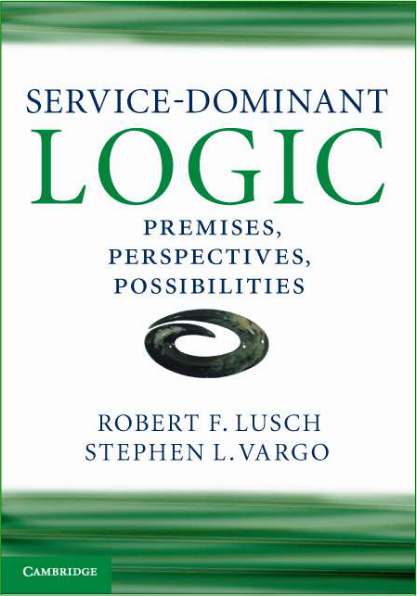
Special Issue: Toward a Better Understanding of the Role of Value in Markets and Marketing Editors: Stephen L. Vargo and Robert F. Lusch ISBN: 9781780529127

Contacts

Robert F. Lusch 
University of Arizona 
Phone:(520) 621-7480 
Email: rlusch@sdlogic.net

Stephen L. Vargo
University of Hawaii
Phone:(808) 956-8167
Email:svargo@sdlogic.net

Links

www.openinnovation.com

IBM Almaden Services Research

Center for Services Leadership

Center for Excellence in Service

The Otago Forum

Sense and Respond

www.openinnovators.net

Naples Forum on Service

Service Research Center

Foundational Premises and Concepts of S-D Logic

Service-dominant logic is captured in ten foundational premises (FPs), which were intended to establish a framework for the service-centered mindset (see first exhibit below). Many of the concepts (e.g. value co-production/co-creation, value propositions and experiences) underlying this mindset, and thus the FPs, are neither exclusive to nor invented by S-D logic itself (see second exhibit below). Rather, S-D logic captures shifting contemporary marketing thought, in which marketing is seen as a facilitator of ongoing processes of voluntary exchange through collaborative, value-creating relationships among actors (individuals and organizations for example).


Foundational Premises (FPs) of S-D Logic

FP1 Service is the fundamental basis of exchange.
FP2 Indirect exchange masks the fundamental basis of exchange.
FP3 Goods are a distribution mechanism for service provision.
FP4 Operant resources are the fundamental source of competitive advantage.
FP5 All economies are service economies.
FP6 The customer is always a co-creator of value.
FP7 The enterprise cannot deliver value, but only offer value propositions.
FP8 A service-centered view is inherently customer oriented and relational.
FP9 All social and economic actors are resource integrators.
FP10 Value is always uniquely and phenomenologically determined by the beneficiary.
Source: Vargo and Lusch (2004), “Evolving to a New Dominant Logic for Marketing” Journal of Marketing 68(January), 1-17. Vargo and Lusch (2008), “Service-Dominant Logic: Continuing the Evolution” Journal of the Academy of Marketing Science 36(Spring), 1-10. 

Underlying Conceptual Transitions to a S-D Logic

Goods Dominant Logic Concepts Transitional Concepts S-D Logic Concepts
Goods Services Service
Product OfferingsExperiences
Feature/Attribute Benefit Solution
Value-Added Co-ProductionCo-creation of value
Value-in-exchange Value-in-use Value-in-context
Profit Maximization Financial EngineeringFinancial feedback/learning
Price Value Delivery Value Proposition
Equilibrium Systems Dynamic SystemsComplex Adaptive Systems
Adapted from: Lusch and Vargo (2006), “Service Dominant Logic: Reactions, Reflections, Refinements” Marketing Theory 6(3), 281-288. 

Web Hosting by StartLogic